Barrels
The Barrel is a device that can hold both items and fluids. The central slot is used to hold items. Fluids are shown in the tank on the left side, and can be added to the barrel by placing a filled bucket or jug in the top left slot. They can be removed by placing an empty fluid container in the same slot. Using Right Click on the block with a bucket also works.
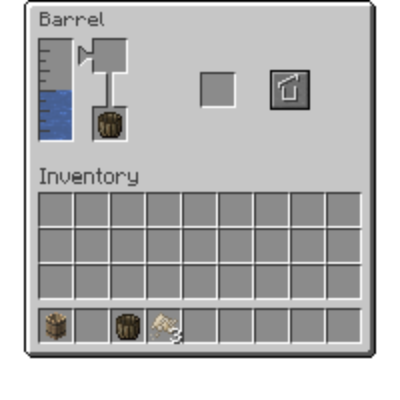
The barrel interface.
Barrels can be Sealed. Sealing allows the barrel to be broken while keeping its contents stored. It also allows for the execution of some recipes. In the interface, sealing can be toggled with the grey button on the right side. Using Right Click on the barrel with an empty hand while holding Shift also toggles the seal.
Barrel Tips
- Barrels can be filled by clicking an empty one on a fluid block in the world.
- Barrels will slowly fill up with water in the rain.
- Icicles melting above barrels also adds water to them.
- Sealing a barrel will eject items that are not in the center slot.
Crafting
Barrels are an important device used for mixing various fluids and items together. To use a Barrel recipe, the barrel must be filled with the correct ratio of fluid and items required. Depending on the recipe, it may need to be Sealed for a period of time to allow the contents to transform.
If the contents of a barrel does not match the ratio required for the recipe, any excess fluid or items will be lost. If the recipe is one which converts instantly, however, you will always need at least enough items to fully convert the fluid, according to the recipe.
Limewater is made by adding Flux to a barrel of Water. A single Flux is required for every 500 mB of Water. Limewater is a reagent used in Leather Making, and is used to make Mortar.
Tannin is an acidic fluid, made by dissolving bark from certain Logs in a barrel of Water. Oak, Birch, Chestnut, Douglas Fir, Hickory, Maple, and Sequoia are all able to be used to create Tannin.
TIP: Search EMI for #makes_tannin for a full list of useable logs.
Fluid Mixing
Some barrel recipes operate by mixing two fluids at a certain ratio. This is done by taking a filled bucket of one of the ingredients, and putting it in the fluid addition slot of a barrel that has the required amount of the other fluid. This is done with Vinegar and Salt Water to make Brine in a 1:9 ratio.
Quenching
Barrels have the ability to cool hot items. Put a hot item in a barrel of Water, Cooking Oil, or Ice Slush, and it will quickly bring its temperature down.
You can even directly throw items into the barrel with Q.
Dyeing
Barrels have the ability to Dye and Bleach items. Most color-able things, like carpet, candles, and Alabaster can be dyed by sealing them in a barrel of dye or bleached by sealing them in a barrel of lye.
Preservation
Barrels can preserve items in Vinegar. Vinegar is made by sealing Fruit in a barrel of Alcohol. For information on how that process works, see the relevant page.
Barrels placed against the side of a block work the same as vertical barrels, but have restrictions on placement. For example, they must have a Barrel Rack added to them with Right Click in order to have another sideways barrel above them.
Sideways Barrels
Sideways barrels show their sealed state using the Tap. If the tap is sideways, it is sealed.
Unsealed sideways barrels automatically drain their fluid into open barrels (and other fluid containers) placed below the tap. The block the tap extends into must be a free air block in order for fluid to be able to drain.
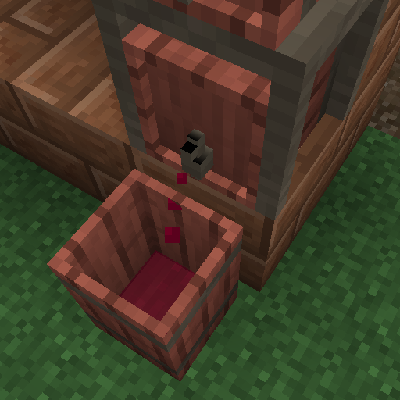
A barrel dripping.
Redstone
Barrels can be automated with Redstone. Applying a redstone signal to a barrel will seal it. Unsealed barrels can have fluids and items inserted and extracted from their open face. Sealed barrels can safely be moved around with Pistons or Contraptions. A Precision Clock can detect when a barrel recipe has finished and output a signal.
Comments