Clay & Pottery
Clay
Clay is an incredibly useful and balanced material which can be used for pottery. It can prove challenging to locate at first. Clay is usually hidden by grass, but it is often found in two locations. In areas with at least 175mm Annual Rainfall, clay can be found in patches all over the place, usually marked by the presence of certain Plants.
Clay Indicators
Clay, with the plants that may indicate its presence.
Athyrium Fern, Canna, Goldenrod, Pampas Grass, Perovskia, and Water Canna all indicate the presence of clay nearby. Clay can also be found in smaller deposits close to water sources, such as rivers, lakes, or ponds.
Like with rocks, clay can be knapped to form new items. It requires five clay in your hand to knap. Unlike rocks, if you make a mistake, you can simply close the knapping interface, reshape your clay, and try again.
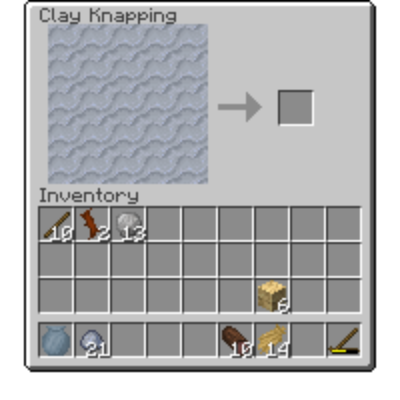
Yontma menüsü
Small Vessel
The small vessel is one such item. Like all pottery items, it must be fired before it can be used. Firing is a process of heating the item up to a point where the clay will turn into a hard Ceramic material, which requires heating to 1400 °C, or Yellow White.
In order to do this in the early game, you will need to use a Pit Kiln.
Small Vessels can store items to save space in your inventory as well as Preserving Food Items. Small vessels have a limit of 16 items per-slot and cannot fit items larger than "small".
Jug
Another useful pottery item is the Jug. It can be used to pick up and drink fluids, such as fresh water.
In order to use it, simply Right Click the jug on the fluid in the world. Then use the jug in order to drink from it. The jug is a Drinking Container that can hold 100 mB of fluid at a time.
Molds
Clay is also necessary for making Molds. Molds can have molten metal poured into them, which will eventually solidify into the shape of a mold. The item and potentially the mold can then be retrieved by using Right Click on the mold or putting it in your crafting grid.
All molds have a limit of not being able to contain molten metal past the bronze-age, except ingot molds.
Mold Types
Mold Types
There are many different types of molds. The most useful of which are the Ingot and Tool Head molds.
Ingot molds require 144mb of molten metal to produce one ingot.
Tool head molds replace traditional stone knapping for tools and usually require 144mB of fluid, however some tool types may require less or more.
The mold then needs to be fired―like all clay items―to be usable, such as in a Pit Kiln.
Once it is fired, molten metal can be poured in. Once the metal has cooled enough, it can be extracted.
Casting
You will very likely run into scenarios where you produce tiny amounts of excess melted metal. It is recommended to pour it into an ingot mold and save for the next time you need to cast that metal. Trying to produce perfect 144mB ratios of alloys is not feasible or worth the effort until you reach steam-age processing.
Kaolin Clay
Kaolin Clay is required to make Fire Clay. It can be found spawning between Y=75-110 in Plateaus, Rolling Hills and Highlands (and in their Karst variants), Old Mountains, and Shield Volcanoes at a temperature of at least 18°C, with a rainfall of at least 300mm. The Blood Lily flower grows on Kaolin clay, which can be up to 35 blocks below.
If you see the flower but there's no clay on the surface, dig deeper!
Unless you selected the Tropical climate when creating your world, the journey to obtaining Kaolin Clay may be long but is always a memorable part of TerraFirmaCraft. It is important to prepare for the trip, such as through equipment, a boat, extra storage, food and drink, and a Spade to dig it all up with.
Generally, go South East to increase temperature and humidity to reach the ideal climates.
If you're not a fan of long journeys, get seasick easily, or are very unlucky, TFG has another option for obtaining Kaolin Clay: visiting The Beneath! It requires less traveling but is far more dangerous... with the potential for even greater riches!
Kaolinit Tozu
Kaolinite powder is made by heating Kaolin Clay. However, the process is not perfect, and only 20% of clay will form powder!
In order to mass produce kaolinite powder early on, it is recommended to fill small vessels with kaolin clay blocks and then place these vessels in a Pit Kiln to cook on-site. With this method you can cook up to 1,024 kaolin clay at a time per pit kiln.
The amount of kaolinite powder you will need is enormous. If you have traveled very far to acquire kaolin clay and wish to make the most of your trip it is recommended to not return until you have at least 7 stacks (448 items) of Kaolinite Powder. This will ensure you have enough for a full-size Blast Furnace, Crucibles, and molds. You should also bring back at least 20 blocks of kaolin clay for Glassworking.
Fire Clay
Ateşe Dayanıklı Kilin kullanım yerleri az ama kullanıldığı yerler bayağı önemlidir Kilin ateşe dayanıklı versiyonu olduğu için senin ateşli işlerini çözmek için bire bir!
Fire clay is made from Graphite crushed in a Quern, as well as Kaolinite Powder.
Steam machines unlock more efficient ways to craft fire clay, so you may want to save some of your ingredients for later.
Fire Ingot Molds are a stronger type of Ingot Mold that has just a 1 in 100 chance of breaking, compared to 1 in 10 for a regular ingot mold.
Comments