Earth Geology
The world of TerraFirmaGreg is divided into large continents - landmasses many kilometers wide and seperated by oceans. In these, you may find mountain ranges, rivers, and many other formations. Here you will learn about the geology of Earth and how rock layers are determined.
- Rock Layers
- Metamorphism
- Ocean Floors
- Uplift Regions
- Rock Devisions
- Sedimentary
- Metamorphic
- Igneous Extrusive
- Igneous Intrusive
- Rock Classifiers
- Sedimentary-Carbonate
- Sedimentary-Clastic
- Sedimentary-Organic
- Igneous-Felsic
- Igneous-Intermediate
- Igneous-Mafic
- Igneous-ultramafic
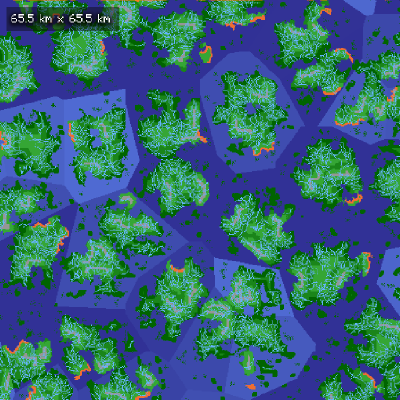
A 65.5km² map displaying average continental formations and mainstream rivers with their tributaries.
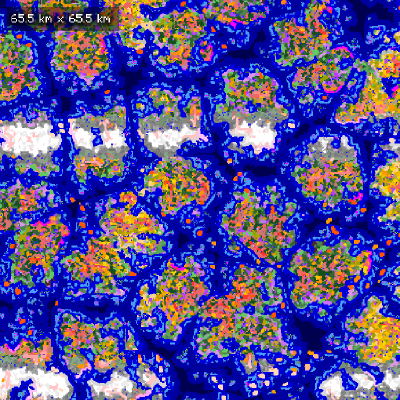
A 65.5km² map displaying average biome distribution based on local Climate.
Rock Layers
The world is divided up into different types of Rock. Rock regions can be over a kilometer across, and there will usually be two or three different rock layers under your feet at all times. As different ores are found in different rock types, locating specific rock types can be very important for finding resources such as Ores, which will often only appear in certain rock types.
The top layer of rock on a continent will either be igneous extrusive, or sedimentary. Underneath sedimentary rocks will likely be metamorphosed forms of the rock above.
For example, Marble (a metamorphic rock) will likely be found under Limestone or Chalk. High grade metamorphic rocks are found deep under other metamorphic or igneous rocks.

The cross-section of a TFC world.
Metamorphism
- Slate forms under Shale, Claystone, and Conglomerate.
- Marble forms under Limestone, Dolomite, and Chalk.
- Quartzite forms under Chert.
- Phyllite forms under Slate
- Schist and Gneiss form under Phyllite, or other igneous intrusive rocks.
Ocean Floors
Ocean floors are composed of igneous extrusive rock - rocks that are formed by magma which cools quickly. Underneath igneous extrusive rock will likely be a igneous intrusive rock of the same grade.
For example, under Basalt (a mafic, igneous extrusive rock), will likely be Gabbro (a mafic, igneous intrusive rock).
Uplift Regions
Finally, in mountainous regions you might also see uplift, where a metamorphic or igneous intrusive rock is found on the surface. Uplift rocks can be found above other continental sedimentary or higher-grade metamorphic rocks.
In addition, Dikes - small vertical slices of igneous intrusive rock - may appear scattered around the world.
Rock Devisions
Rocks in TFG are typically classified among four devisions: Sedimentary, Metamorphic, Igneous Extrusive, and Igneous Intrusive. These categories determine where the rock can spawn, and also what ores may spawn in this rock.
Sedimentary
Sedimentary rocks are formed by the accumulation or deposition of mineral or organic particles. They are typically found on the top layers of rock in continental areas.
Metamorphic
Metamorphic rocks are created by a process called metamorphism. They can be found underneath corresponding sedimentary or igneous rock, or in uplift areas.
Igneous Extrusive
Igneous Extrusive rocks are formed from magma cooling on the Earth's surface. They can be found on the top layer of rock in continental areas, or on the floor of oceans.
Igneous Intrusive
Igneous Intrusive rocks are formed from magma which cooled under the Earth's crust. They can be found deep underground, or rarely in dikes or uplift areas.
Rock Classifiers
On top of Rock Devisions, rocks are further categorized by their chemical compositions.
Sedimentary-Carbonate
Sedimentary-Carbonate rocks are composed primarily of carbonate minerals like calcite.
Sedimentary-Clastic
Sedimentary-Clastic rocks are composed of fragmants (clasts) of pre-existing minerals or rocks.
Sedimentary-Organic
Sedimentary-Organic rocks are formed from the breakdown or fossilization of organic matter like shells or bacteria.
Igneous-Felsic
Igneous-Felsic rocks contain a rich presence of elements that form feldspar and quartz. Generally a rock must contain more than 75% of felsic minerals to be classified as Felsic.
Igneous-Intermediate
Igneous-Intermediate rocks contain 51.5 - 63.0 wt% SiO₂, putting them in between Felsic and Mafic compositions.
Igneous-Mafic
Igneous-Mafic rocks contain a rich presence of magnesium and iron minerals.
Igneous-Ultramafic
Igneous-Ultramafic rocks contain a very low concentration of silica.
Comments